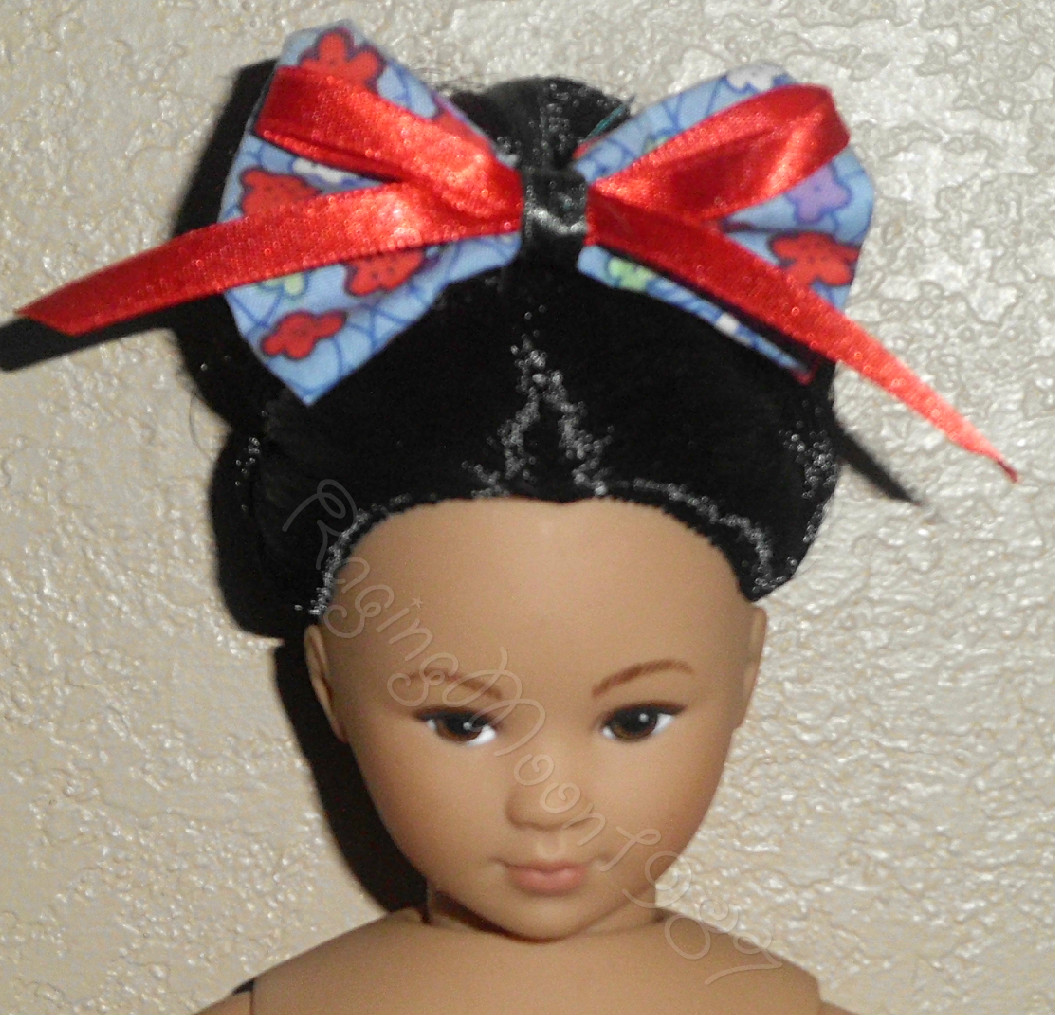
The Girls of Many Lands were released by Pleasant Company, the same crowd that did American Girls for some years (you may recall that my Denise is a Pleasant Company doll). The series ran from 2002 to 2005. I received my Kathleen in the October of 2003 (my sixteenth birthday, to be exact), meaning that she'd just been released when I got her. According to agplaythings.com, she was retired in mid-2004, which makes me wonder how many were actually made. Anyway, Kathleen and her dolly sisters are a little over nine inches tall and are made of high-quality plastic; I originally thought that Kathleen's head was porcelain, in fact. They were not meant to be toys but rather nice things to be enjoyed by older girls, and this aspect may have been what contributed to the brief run. The line had eight dolls released in two waves. In a way they combined the Dolls of All Nations with the historical American Girls; each of them had a country and a year assigned, and each came with a book. The first wave was released around Christmas of 2002 and included these five girls:
*Neela Sen, from India (1939)
*Isabel Campion, from Tudor-era England (1592)
*Cecile Revel, from France (1711)
*Chou Spring Pearl, from Qing Dynasty China (1857)
*Minuk, from Yup'ik Alaska (1890)
The second wave came around in fall of 2003 and added three new girls:
*Saba, from Ethiopia (1846)
*Leyla, from Turkey (1720)
*Kathleen Murphy, from Ireland (1937)
Spring Pearl and Minuk were my childhood favorites, so they may join my group one of these days. But frankly, it's impossible to pick a bad doll out of this line; all of them are stunning. They all came in big, nice boxes like this:

The box is six and a half inches wide, eleven inches tall, and six inches deep. It closes with a ribbon tie and is made of shiny, heavy-duty cardboard. It's nice enough to be used as a trunk, and I have done so in the past. The box also holds an element of surprise; one has to open up the front of it to see which doll is in there (that was an exciting box opening for my sixteen-year-old self). Here's what it looks like inside.

The doll fits into the compartment on the right, though it's quite roomy. Kathleen was tied in when I first got her, and she'd need something to hold her steady if I had to put her back in there for an extended period. The left side of the box has a place for the book that Kathleen came with. Unfortunately, my book is in storage somewhere; I haven't cleaned my room since we moved into this house back in 2011, so God knows where that book is. The book is a chapter book about Kathleen's life, and it's...it's pretty interesting. I don't want to give away too much, but I can give you some basics on my girl's personality. Kathleen is twelve years old (as are all the Girls of Many Lands). She lives with her parents and four siblings in pre-WWII Dublin, is the eldest child of the family, and finds an escape from her impoverished state in step dancing. With that said, let's start from the top down.

Kathleen is wigged...literally (LOL). She's a redhead, like most of the Irish dolls I've seen, and her hair is styled up in nine very tight barrel curls. We're not talking ringlets, like I usually see on dolls, but honest-to-God tubes of hair. The top of her head is covered by this green beret-style hat.

I'm not sure if the hat can be removed or not, and I'm not too keen to attempt it lest I upset the curls. The hat has a small pin and a yellow feather on it. According to the book, the pin bears the insignia of the dancing school that Kathleen attends. The feather also has some significance, but I'm not going to say what. Let's look at the face instead.

Kathleen's features are painted. She's got orangish lips, feathered orange eyebrows and a bevy of very tiny freckles painted on her nose and cheeks. Her eyes are two shades of green and are painted looking off to the left (her right). There are some light shadows painted underneath each eye, but no makeup. Her profile is relatively flat.

Here is where I once again found myself thinking "she reminds me of another doll!" I thought the same thing when I was sixteen, but lacking both Internet access and a full knowledge of the doll world I shrugged it off and went on with my life. But a few years ago I made an interesting discovery: Kathleen and her Girls of Many Lands sisters were all designed by a well-known doll artist. If you don't know who, I'll give you a hint:

That's Riley, in case y'all don't know her. Kathleen reminds me more of Riley's friend Tulah because they both have red hair, but look at this Riley's eyes...and the lips...and the flat, broad nose. Now look at Kathleen's features again (I tried to make her picture look similar to Riley's).

They aren't exactly the same but they ARE similar, and for good reason. The Girls of Many Lands were manufactured by Pleasant Company, but they were designed by Helen Kish, the same person who designed Riley and Tulah. I've always been a fan of Helen Kish's work but her prices are pretty steep, so when I found out that I already had a Kish-designed doll in my collection I was thrilled. Plus, if I ever do get my hands on another Kish doll I'll have someone to compare her to. I'm particularly interested in finding out if Kathleen and Riley can share clothes.
But then again, maybe that wouldn't be the smartest idea. Kathleen's outfit is attached with snaps and Velcro, but I don't think she's meant to be undressed. Not that that matters much; that outfit is exquisite! Remember back at the beginning when I said that Kathleen was a dancer? Her outfit is a reflection of that.

The dress is the kind worn at feisanna, or traditional Gaelic arts festivals. Kathleen explains in her book that song, poetry, artistry, and dance are all parts of feisanna in her time, and the same is true today, though the dances are a lot bigger. The dresses are also a lot fancier, with some dancers looking like they're about to appear on an episode of "Toddlers and Tiaras." Kathleen, thank God, couldn't afford to be that showy. Her dress is made of green wool and has a Celtic knot embroidered on the chest.

Areas like this can potentially be landmines for sewing gaffes, but my Kathleen's embroidery is rock-solid. Her sleeves are flared and have gold satin edging. The gold material extends up into the sleeve.


Her skirt is pleated, as is common for Irish dancing dresses.

Sewn to Kathleen's waist are these three silver medallions. These are her dance competition medals, given to those who win the whole shebang. In real life they are plastic, but in the story these were made of silver.

Kathleen has a fourth medal on a cord around her neck.
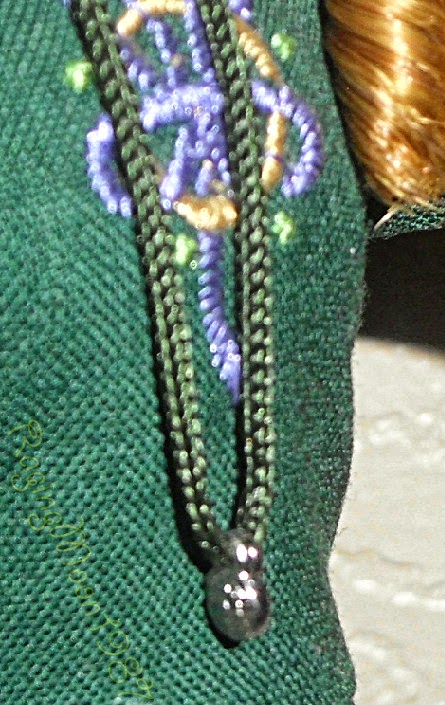
She was originally holding this, but I was afraid the rubber band that held it on would break, so I somehow managed to get the cord around her neck. Not the easiest task in the world with those stiff little curls, but I did it.
Attached to Kathleen's shoulders is the brat (pronounced "brath"), or shawl. It too is green and is lined with yellow silk.


Celtic knots adorn the both corners of the brat. Again, I found no flaws in the sewing.

Sewn to the shoulder straps are two more school badges.

These straps fasten onto the main dress with snaps at the shoulders and with small stitches at the hem of the skirt. I don't know if the brat and dress are sewn together like that on real dresses, but it makes sense. The skirt helps the brat hold its shape; if the two weren't sewn together then Kathleen would probably look like a cross between a leprechaun and Superwoman.
The rest of Kathleen's outfit consists of a pair of black knit tights and black pleather shoes that are held on with elastic laces.

Oh yeah, she also "wears" this stand, which grips her by the legs.

The stand is made of smooth, hard plastic and is about three quarters of an inch thick. Kathleen leans back a bit in the stand, but it's still head and shoulders above Cyanne's stand. The only time Kathleen is in risk of falling over is if I place her on a surface that's unsteady to begin with...and that's MY fault, not hers!
In theory I suppose that Kathleen could be undressed, but I've never gone further than unsnapping the brat or occasionally removing a shoe. Thus I can't really give you a detailed body review...but I CAN tell you what she's made of and give you a basic idea about articulation. Kathleen's head, torso, arms, and legs are all made of a matte, porcelain-like plastic. She has five joints: shoulders, hips, and neck. The arms and legs are strung but don't have a lot of movement. Usually when I have Kathleen out and about I leave her arms down at her sides, but she can lift them all the way up.

"Huzzah!"
The legs have similar movement. Kathleen can't sit, nor was she meant to, but she does have some lateral movement in her hips...

...and some nice back and forth movement.

Kathleen's head is a separate piece from her neck, unlike Midori and the Living Dead Dolls. She can turn her head in both directions.

"I see you."

"Eeek!!! What a big cat!"
She can also tip her head in both directions, but I think that may be because of the neck joint, not because she was meant to hold her head that way.
The hands have molded fingernails and creases on the knuckles, but the knuckles are not well-defined.

I have never removed Kathleen's shoes and tights to look at her feet, and I don't plan on doing so because the shoes are hard to get back on. However, if you look at publicity pictures of Saba (who wears sandals) or Neela (who wears no shoes at all) then you can see that these dolls have very detailed feet, with individual toes and molded toenails. Just like Midori.
Regarding height, Kathleen is the smallest doll I've reviewed so far, and she's one of my smallest overall. She's shorter than both Cyanne, my La Dee Da doll, and Wendy, my Little Miss Revlon doll (both are ten inches).

Kathleen may be smaller than Wendy and Cyanne, but her proportions are more realistic. Her head is a realistic size in relation to her body, and she doesn't have an overabundance of hair. Little Miss Revlon dolls are supposed to be young women, but Kathleen looks far more elegant and mature than my Wendy does. She makes Cyanne look downright comical.
Daniela is taller than Kathleen too.

"Who is this stranger an' why is she holdin' me?"
I find the size difference between Daniela and Kathleen interesting, because the two are supposed to be around the same age. Yeah, they're from different companies, but I still think the difference is worth noting.
Since I mentioned Midori earlier, and since her review led to this one in the first place, let's see how she and Kathleen compare.

"Konichiwa, small redhead!"
At twelve inches, Midori is quite a bit taller than Kathleen, though her tall shoes add some height. Both dolls have five joints, but the mobility differs. Midori has no lateral movement in her limbs at all...

...but she has a better neck joint.

Midori's clothing is detailed, but the material is stiff and not hemmed in places. Kathleen's clothes feel nicer and are hemmed where they need hemming, but they don't feel as substantial.

Notice the loose threads hanging off the bottom edge of Midori's kimono.
Midori's hands are more detailed, but Kathleen's plastic feels superior.

Both dolls have very elaborate, high-quality hair in styles that I can't recreate if something happens. Midori's is rooted and Kathleen's is wigged, but the two are pretty even. If I were nitpicking I might knock off a couple of points for Midori's exposed rubber bands, but that's about it.

Both dolls have painted faces, and their faces are painted in a similar manner. They both have slight smiles and side-glancing eyes. However, Kathleen's face has more character, and she's got a lot of details packed onto a small surface. This picture doesn't show her freckles too well, but they're there.

Just for the say-so of it, let's compare Kathleen with Maeve, my Dolls of the World Barbie. Here's what they look like together.

Maeve is taller than Kathleen by quite a hair, though her stand helps her somewhat. She's more poseable, she has gorgeous amber eyes, her outfit's a great shade of green, and I absolutely love her fiery hair. And hey, she's also got a cute little dog!

I named him "Bailey," after Baileys Irish Cream.
However, when compared to Kathleen Maeve's face is overly made up and her clothing feels cheap. This makes sense, because she cost half of what Kathleen did back in 2004. But really, it doesn't seem fair to compare Maeve to Kathleen. The two dolls are in different leagues. This surprises me a little since Maeve is supposed to be a Barbie for collectors, but the only way she tops Kathleen is in the hair color department...and maybe the eye color. Perhaps if I had THIS Irish Barbie the playing field would've been more level (her dress is made of real linen). For the record, Kathleen and Maeve still display nicely together...and they appear to be making friends!

Now for the fun part: good stuff/bad stuff.
BAD
*Discontinued, first and foremost. That makes finding these dolls harder, and some folks on eBay really jack up the prices.
*Not very poseable, especially compared to some of my other dolls.
*Hair could get messed up.
*Clothing is removable, but it's tricky and I wouldn't attempt it.
GOOD
*She's a redhead (which I love), and that hair is done up in a stunning hairstyle.
*Face has a lot of detail packed onto a small space. No paint flaws.
*Helen Kish designed her!!!
*Clothing is high quality and is covered in little details that tie in with Kathleen's storybook.
*She has a stand, and it works well.
*The packaging can be reused. I can't say that about a lot of my dolls.
*Small size, meaning she can fit just about anywhere (Midori and a lot of my dolls can't).
*Made of high-quality plastic. I go to extra measures to keep the feather in her cap intact, and I'm gentle with her joints, but she doesn't need to be handled with kid gloves.
*There's a potential for learning...for ANYONE. Kids, teens, and adults can all learn a thing or two about Irish culture and language (the book has a small glossary of Irish words in the back).
Kathleen was a gift from my grandmother, so I have always loved her. However, I have never taken the time to really appreciate what a nice doll she truly is. Is she absolutely perfect? No, but no doll is. However, Kathleen comes a lot closer to being perfect than a lot of dolls in this world, because just about everything on the "bad" list can be excused. So she's not poseable. She's not supposed to be! What if her hair is elaborate and could get messed up? It's not supposed to be restyled or brushed! The clothes don't come off? Again, they're not supposed to. The only honest-to-God bad thing that I can name about Kathleen applies to all the Girls of Many Lands: the line is discontinued, and the dolls are getting increasingly difficult to find at a reasonable price. But it can still be done; not everyone on eBay is a price-gouger. If Kathleen really lit your fire, or if one of the other girls caught your eye, then my advice to you is to browse eBay, Etsy, and the secondary market, like I plan on doing this fall (the urge to find Spring Pearl has become overwhelming). Lastly, I owe a debt of gratitude to my friend Talolili for suggesting that I review Kathleen in the first place. It was a smart idea, and I never would have considered it if not for her. Thank you, Talolili!
And to the rest of you, watch for my reviews on Skelita and Sila!
Yours truly,
RagingMoon1987